
Ibiza Real Estate Market 2026: How Tourism Growth Is Driving Property Values
Published by White Island Realty · H1 2026 Market Insights
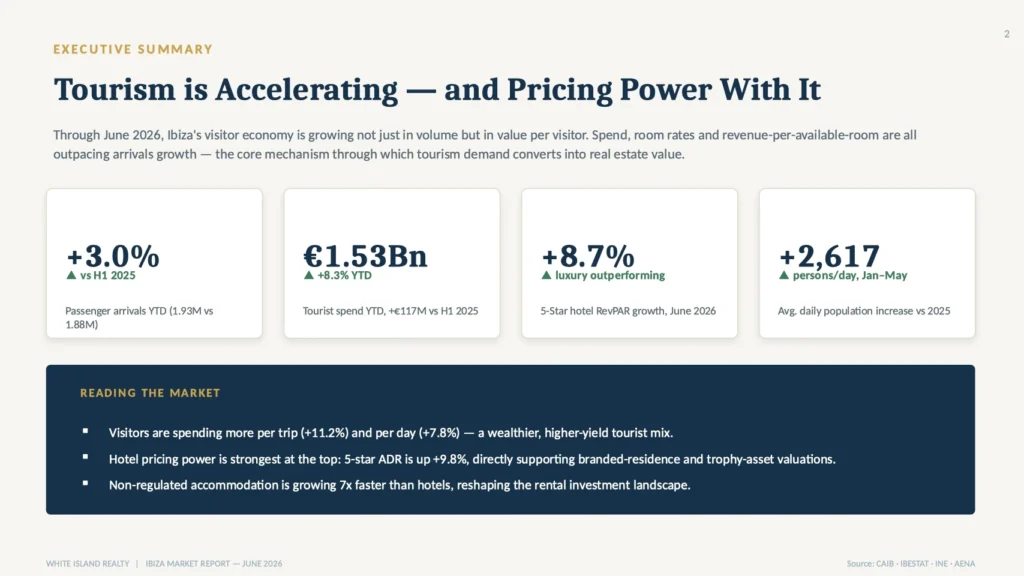
Ibiza’s property market doesn’t move in isolation — it moves with the island’s tourism economy. And through the first half of 2026, that economy is sending a clear signal: visitors are arriving in greater numbers, staying longer, and spending significantly more per trip. For investors, public institutions and high-end buyers watching the Ibiza real estate market in 2026, that combination — volume and value — is the single most important trend to understand.
This article breaks down the key tourism data from White Island Realty’s Ibiza Market Report, June 2026, and explains what each metric means for property values across the island, from hospitality assets to residential real estate.
Key Stats at a Glance
| Metric (YTD, through June 2026) | 2026 | vs. 2025 |
|---|---|---|
| Passenger arrivals | 1.93M | +3.0% |
| Tourist arrivals | 1.415M | +1.9% |
| Tourist overnight stays | 7.09M nights | +5.4% |
| Tourist spend | €1.53Bn | +8.3% |
| Spend per tourist | €1,232 | +11.2% |
| Spend per tourist, per day | €250 | +7.8% |
| Hotel ADR, June (all categories) | €213 | +7.6% |
| Hotel ADR, June (5-star) | €448 | +9.8% |
| Hotel RevPAR, June (all categories) | €177 | +7.3% |
| Hotel RevPAR, June (5-star) | €339 | +8.7% |
| Avg. daily population increase | +2,617 people/day | vs. Jan–May 2025 |
Source: White Island Realty, Ibiza Market Report, June 2026, based on data from CAIB, IBESTAT, INE and AENA.
Ibiza Tourism in 2026: The Numbers Behind the Headlines
Arrivals and Overnight Stays Are Both Rising
Through June 2026, passenger arrivals to Ibiza reached 1.93 million, up 3.0% on the same period in 2025. Tourist arrivals specifically — a narrower measure that excludes resident travel — reached 1.415 million, up 1.9% year-on-year.
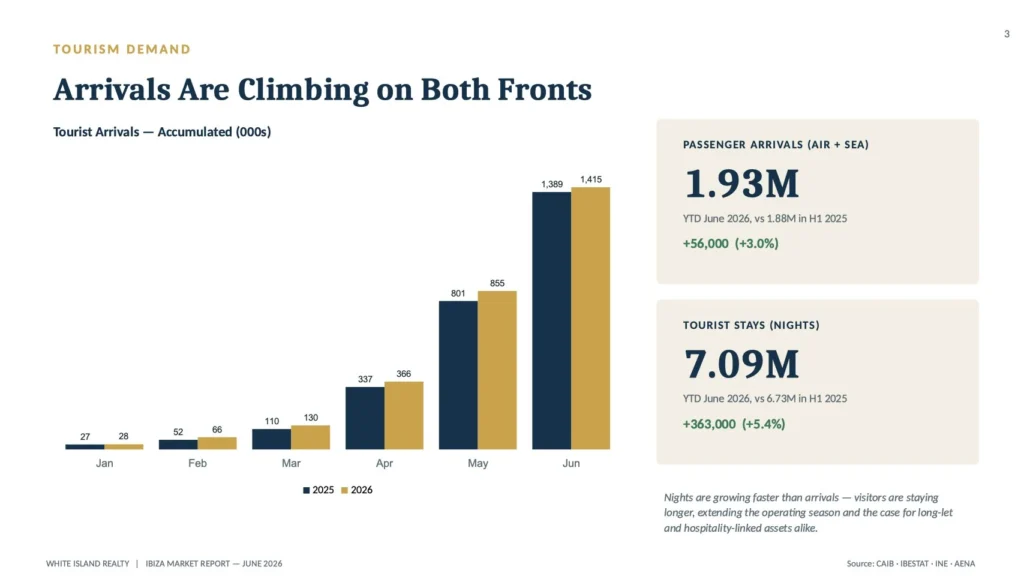
More telling than the headcount is the length of stay. Tourist overnight stays rose 5.4% YTD, outpacing arrivals growth. That gap matters: it means the average visitor is spending more nights on the island than a year ago, which extends the effective operating season for hospitality and rental assets and supports higher annual occupancy.
Visitors Are Spending More Per Trip
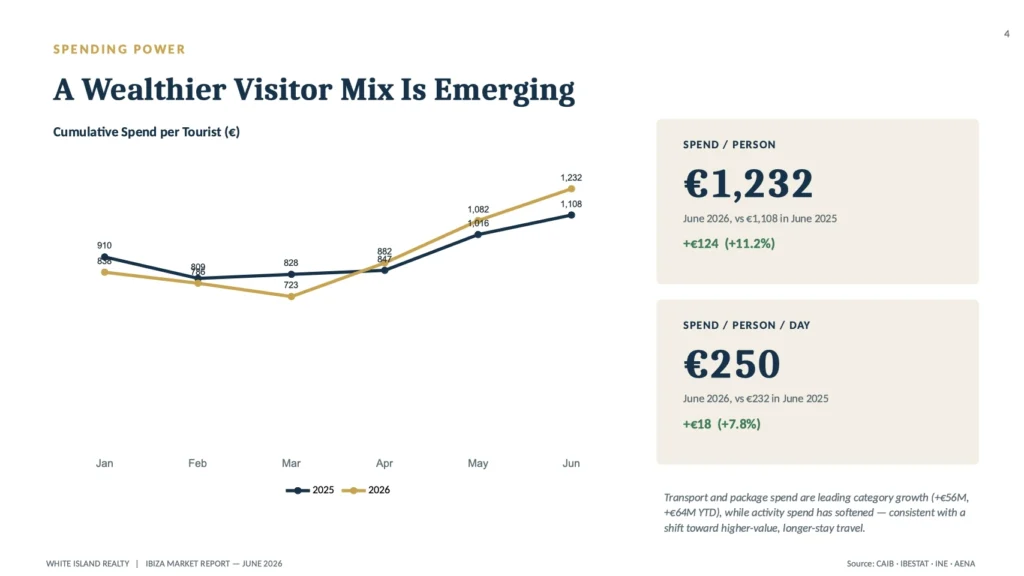
Tourist spend reached €1.53 billion year-to-date, an increase of €117 million (+8.3%) over H1 2025 — growing considerably faster than arrivals. That gap is explained by spend per person, which climbed to €1,232 in June 2026, up 11.2% year-on-year, and by daily spend per person, up 7.8% to €250.
In other words, Ibiza isn’t just attracting more visitors in 2026 — it’s attracting a visitor who spends more. That shift in visitor economics is one of the clearest indicators of demand strength in a tourism-driven property market.
Why Hotel Room Rates Matter for Ibiza Property Values
ADR and RevPAR Explained
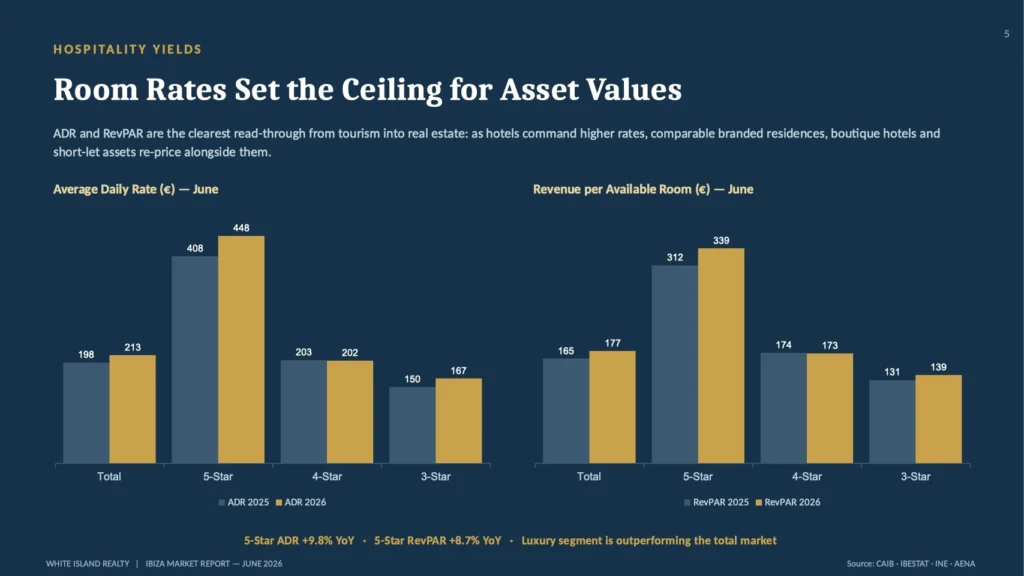
Two hospitality metrics — Average Daily Rate (ADR) and Revenue per Available Room (RevPAR) — are the most direct bridge between tourism performance and real estate value. ADR measures the average price paid per occupied hotel room; RevPAR combines rate and occupancy into a single revenue figure per available room. Together, they are the benchmark against which comparable assets — boutique hotels, branded residences, and premium short-let villas — are priced and valued.
In June 2026, Ibiza’s overall hotel ADR reached €213 (+7.6% year-on-year) and RevPAR reached €177 (+7.3%). Rate growth of this magnitude, sustained across a full high season, tends to feed directly into asset valuations across the wider hospitality and residential property market.
Luxury Segment Leading the Way
The strongest pricing power is concentrated at the top of the market. Five-star ADR rose 9.8% to €448, and 5-star RevPAR rose 8.7% to €339 — both outpacing the 4-star and 3-star categories, where rates were flat to modestly higher. For high-end property buyers and investors specifically targeting Ibiza’s luxury segment, this is a meaningful signal: demand at the premium end of the market is not just recovering, it is out-executing the rest of the island.
Where Ibiza’s Visitors Are Coming From
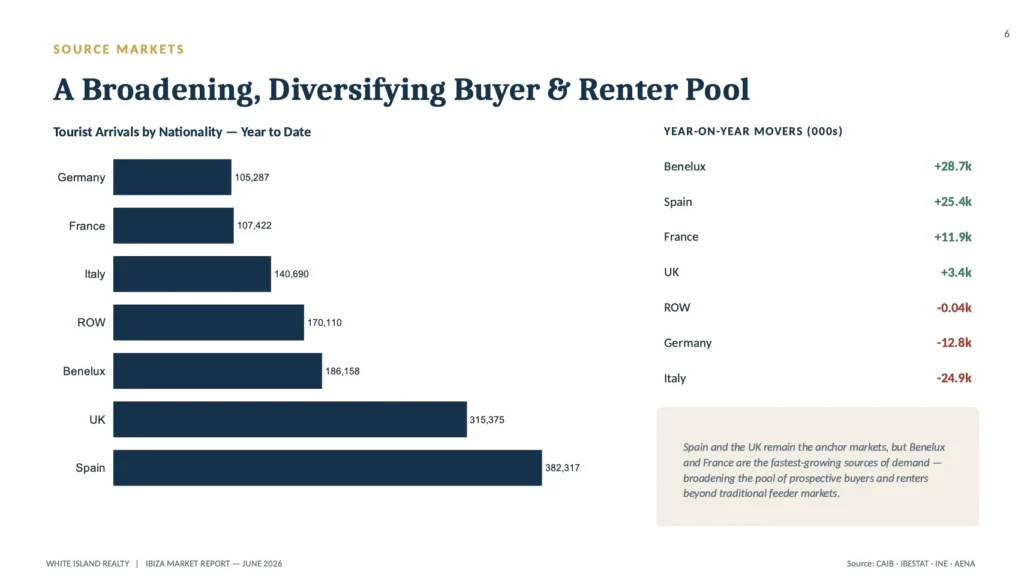
Spain and the UK remain Ibiza’s anchor source markets, together accounting for roughly half of tourist arrivals year-to-date. But the fastest growth is coming from elsewhere: Benelux arrivals are up 28,749 (the largest absolute gain of any market), and France is up 11,863. Germany and Italy, by contrast, have softened, down 12,772 and 24,872 respectively.
For investors, this diversification matters. A property market anchored to two or three feeder markets carries concentration risk; a broadening mix of source nationalities — Spanish, British, Benelux and French demand all growing or holding steady — widens the pool of prospective buyers, tenants and renters an Ibiza property can draw on.
The Shift Toward Private Rentals and Non-Regulated Accommodation
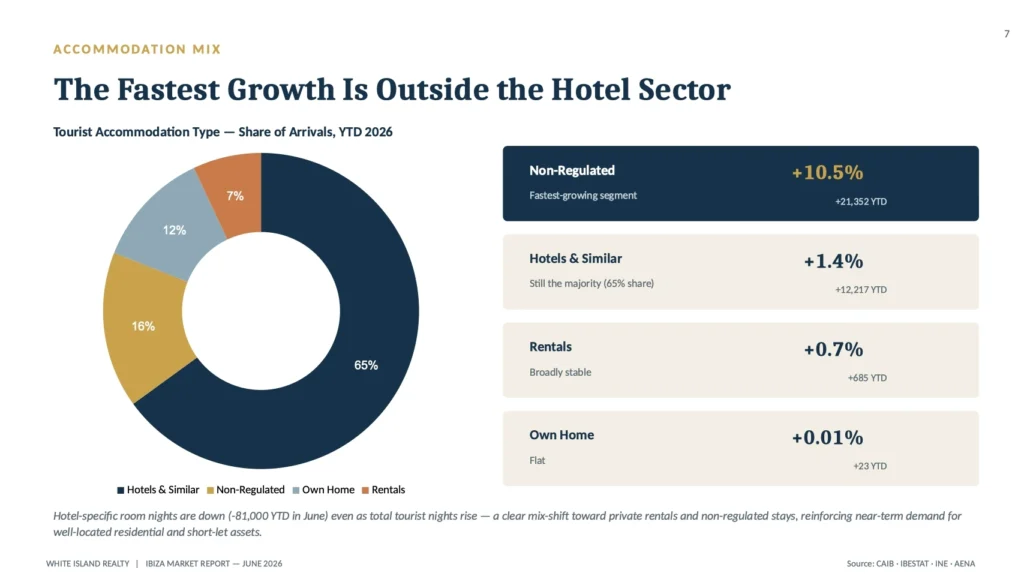
One of the most consequential findings in the 2026 data concerns where tourists are staying. Non-regulated and private accommodation — the category that includes much of the private short-let and vacation rental market — grew 10.5% year-to-date, compared with just 1.4% growth for traditional hotels. In absolute terms, non-regulated stays added 21,352 more tourists than the year before, nearly double the gain in the much larger hotel sector.
Consistent with this shift, hotel-specific room nights were actually down 81,000 in June 2026 even as total tourist nights across the island rose. Together, these figures point to a structural mix-shift of demand away from hotels and toward private rentals — a trend directly relevant to anyone evaluating residential or short-let property as an investment class in Ibiza.
Population Density and the Case for Housing Demand
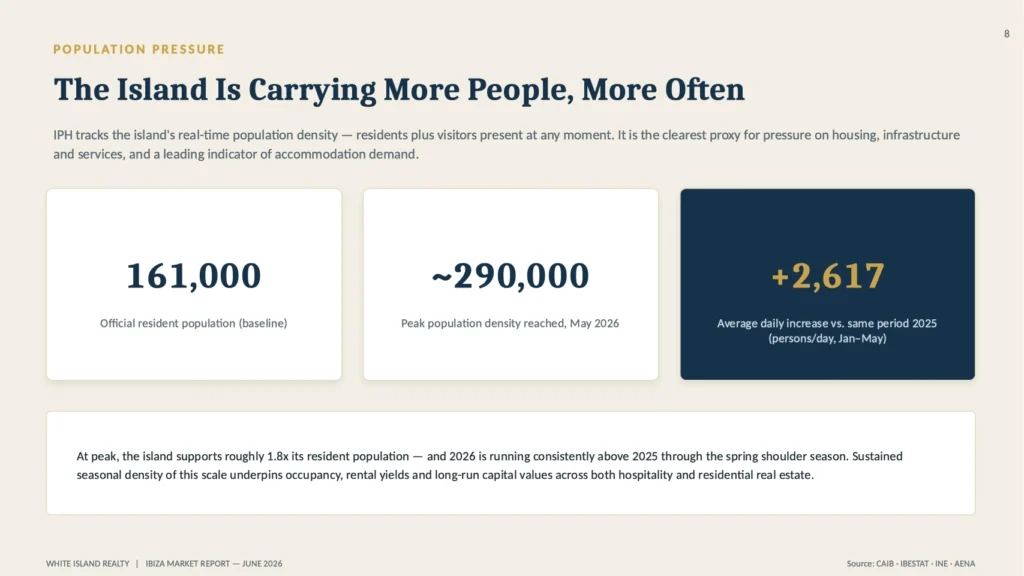
Beyond visitor counts, the report tracks IPH — the island’s real-time population density, combining residents and visitors present at any given moment. Against an official resident population baseline of 161,000, Ibiza’s population density peaked near 290,000 in May 2026 — roughly 1.8 times the resident base — and has run an average of 2,617 people per day higher than the same period in 2025.
Sustained seasonal density at this scale is a leading indicator of pressure on housing stock, infrastructure and services island-wide, and a structural driver of demand for both long-term residential and short-let accommodation.
What This Means for Ibiza Property Investors
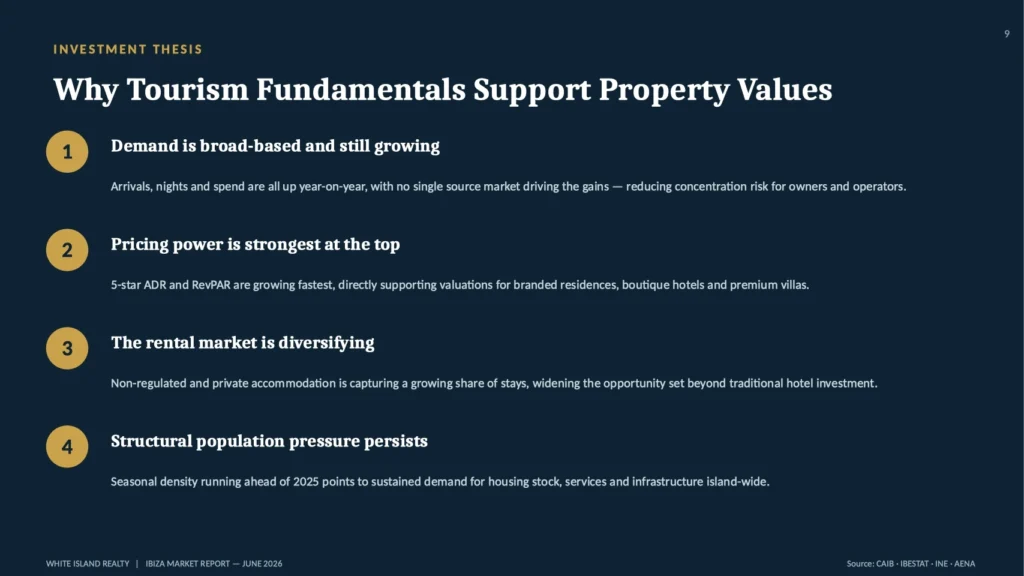
Pulling the threads together, four conclusions stand out for anyone evaluating the Ibiza real estate market in 2026:
- Demand is broad-based and still growing. Arrivals, nights and spend are all up year-on-year, with gains spread across multiple source markets rather than concentrated in one.
- Pricing power is strongest at the top of the market. Five-star ADR and RevPAR are outpacing every other category, directly supporting valuations for luxury villas, branded residences and boutique hospitality assets.
- The rental market is diversifying beyond hotels. Non-regulated accommodation’s outsized growth is expanding the opportunity set for private rental and short-let investment.
- Structural population pressure persists. Seasonal density running ahead of 2025 points to durable, not one-off, demand for housing and accommodation across the island.
Frequently Asked Questions
What is driving Ibiza real estate prices in 2026? Ibiza property values in 2026 are being driven primarily by tourism fundamentals: rising visitor spend, higher hotel room rates and RevPAR, longer average stays, and sustained seasonal population pressure — all of which support occupancy and pricing across hospitality and residential real estate.
Is tourism increasing in Ibiza in 2026? Yes. Passenger arrivals are up 3.0% and tourist arrivals up 1.9% year-to-date through June 2026 versus the same period in 2025, while tourist spend is up 8.3% and overnight stays are up 5.4%.
What is RevPAR and why does it matter for Ibiza property investors? RevPAR (revenue per available room) measures a hotel’s total room revenue divided by available rooms. It is a direct proxy for hospitality asset performance and tends to move in tandem with valuations for comparable real estate. In Ibiza, June 2026 RevPAR rose 7.3% overall and 8.7% in the 5-star segment.
Which nationalities are visiting Ibiza most in 2026? Spain and the UK remain the largest source markets. Benelux and France are the fastest-growing markets year-on-year, while arrivals from Germany and Italy have declined.
Is short-term rental demand growing in Ibiza? Yes. Non-regulated and private accommodation is the fastest-growing lodging category, up 10.5% year-to-date versus 1.4% growth for hotels — a sign of structural demand shifting toward private rentals and short-let properties.
Is now a good time to invest in Ibiza real estate? Current data shows tourist spend, hotel rates and seasonal population density all running ahead of 2025. While no market data guarantees future returns, this combination of broad-based visitor growth and rising hospitality pricing power is generally viewed as a supportive backdrop for property values. Speak with a licensed advisor before making any investment decision.
This article is based on the Ibiza Market Report, June 2026, compiled by White Island Realty from CAIB, IBESTAT, INE and AENA data. For the full report or to discuss the Ibiza property market with our team, contact Clive Heathcote at contact@whiteislandrealty.com or +34 620 085 718.
This content is for informational purposes only and does not constitute financial, legal or investment advice.